Dynkin diagrams
A Dynkin diagram is a picture of a Cartan matrix. Its type, finite, affine, hyperbolic or indefinite, is decided by a symmetric form. For the roots themselves, in rank two and three, see Root systems.
Dynkin and Coxeter diagrams
Cartan matrix
The Cartan matrix
A Cartan matrix is a square matrix of integers with , with for , and with exactly when (a generalized Cartan matrix in [2, Ch. 1]). The simple roots of a root system give a Cartan matrix, with entries
The Dynkin diagram of a Cartan matrix has a node for each . Nodes and are joined when , by lines, with an arrow pointing to node when ; for a root system, the arrow points to the shorter root. When they are joined instead by one thick line labelled [2, Ch. 4]. So a single line is , and a double line with its arrow pointing to node is and .
A Coxeter diagram may also have bonds labelled , which stand for [1, Ch. 5]. The reflections generate the Weyl group of a Cartan matrix [2, Ch. 3], or the Coxeter group of a Coxeter diagram.
Finite, affine and indefinite
The eigenvalues of decide the type of a connected diagram. It is of finite type when they are all positive, of affine type when one is and the others are positive, and of indefinite type otherwise [1, Ch. 6; 2, Ch. 4].
This holds when is symmetrizable, that is, when there are positive numbers with . Then is a symmetric bilinear form on the span of the simple roots, the eigenvalues of are real, and their signs give the signature of the form. When a matrix is not symmetrizable, its eigenvalues need not be real, and it is of indefinite type.
For a diagram of affine type the kernel of the form is spanned by , with positive integers , the numbers on the nodes. A diagram of indefinite type is hyperbolic when every proper connected subdiagram is of finite or affine type [2, Ch. 5].
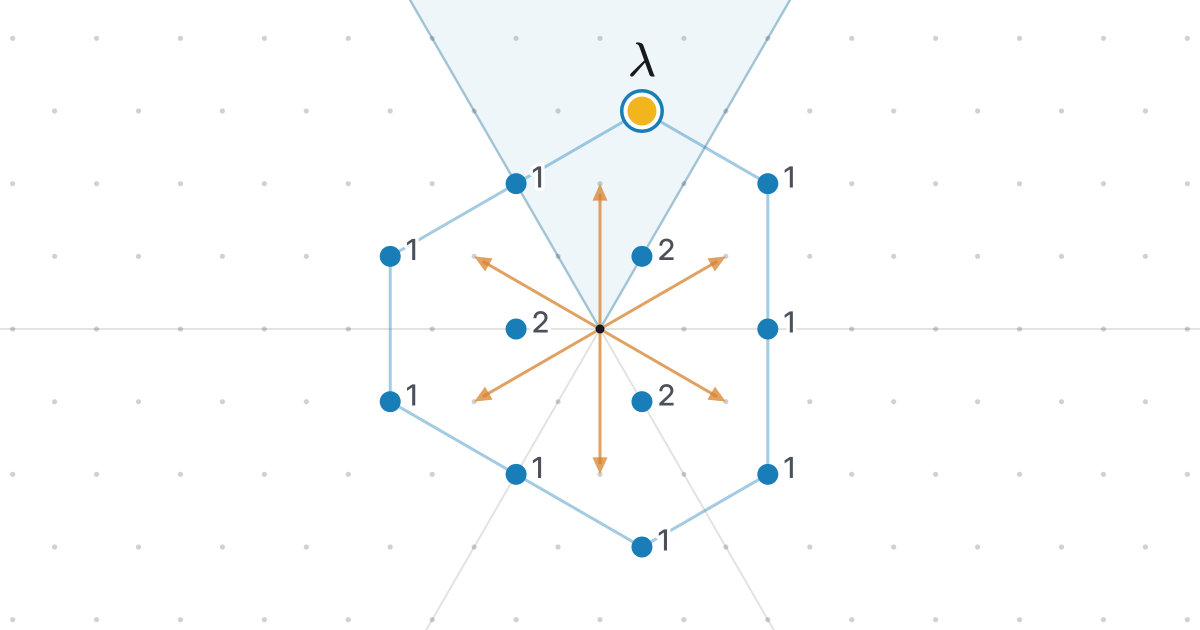
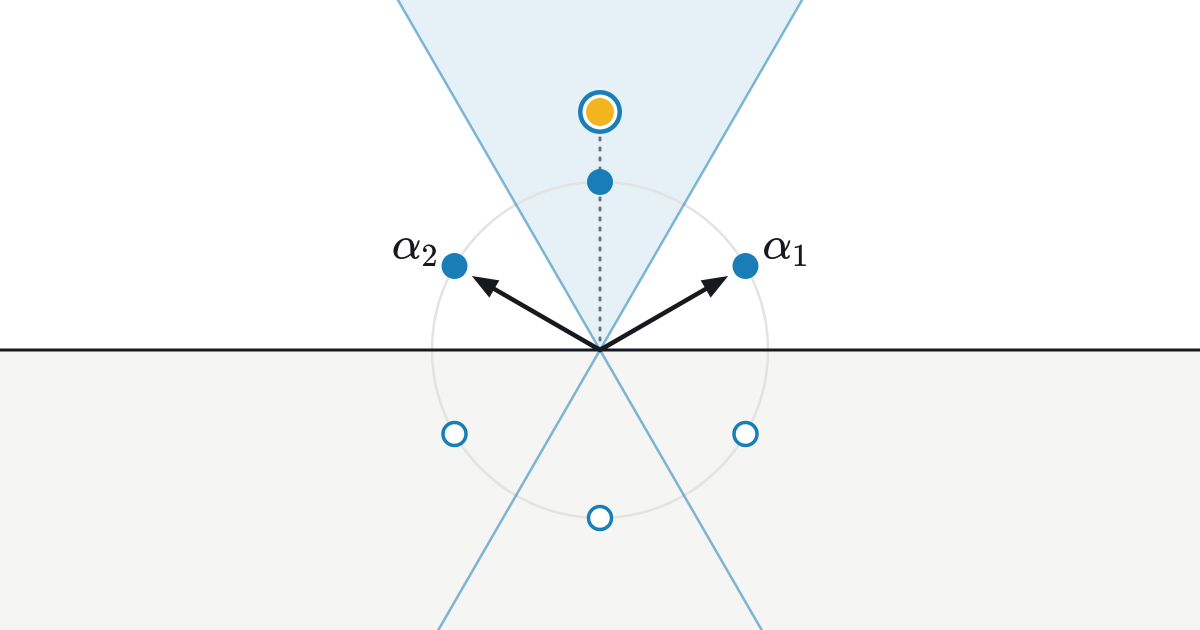
The Coxeter plane
The figure needs a connected diagram of finite type, of rank at least .
For a diagram of finite type the Weyl or Coxeter group is finite. A Coxeter element , the product of the simple reflections in any order, has order , the Coxeter number, and its eigenvalues are
where are the exponents [1, Ch. 3]. The Coxeter plane is the plane on which acts by the rotation through . The roots fall into orbits of , each of roots, and each orbit projects to the plane as a regular -gon [1, Ch. 3]. Each pair of exponents and gives a plane on which turns by ; from rank on, the figure projects the roots to one of these planes, and for depth to one more direction.
Heights and exponents
With a bond labelled , some roots have coefficients that are not integers, such as , and the roots have no heights.
A positive root has height . For a diagram of finite type the numbers of positive roots of heights form a partition, and the conjugate partition is formed by the exponents [3]. So there are roots of height , the simple roots, and the highest root has height .
For a diagram of affine type a real root plus is again a real root, where is the of the name , so the numbers repeat. For affine and indefinite types there are infinitely many real roots, and the figure counts them up to height .