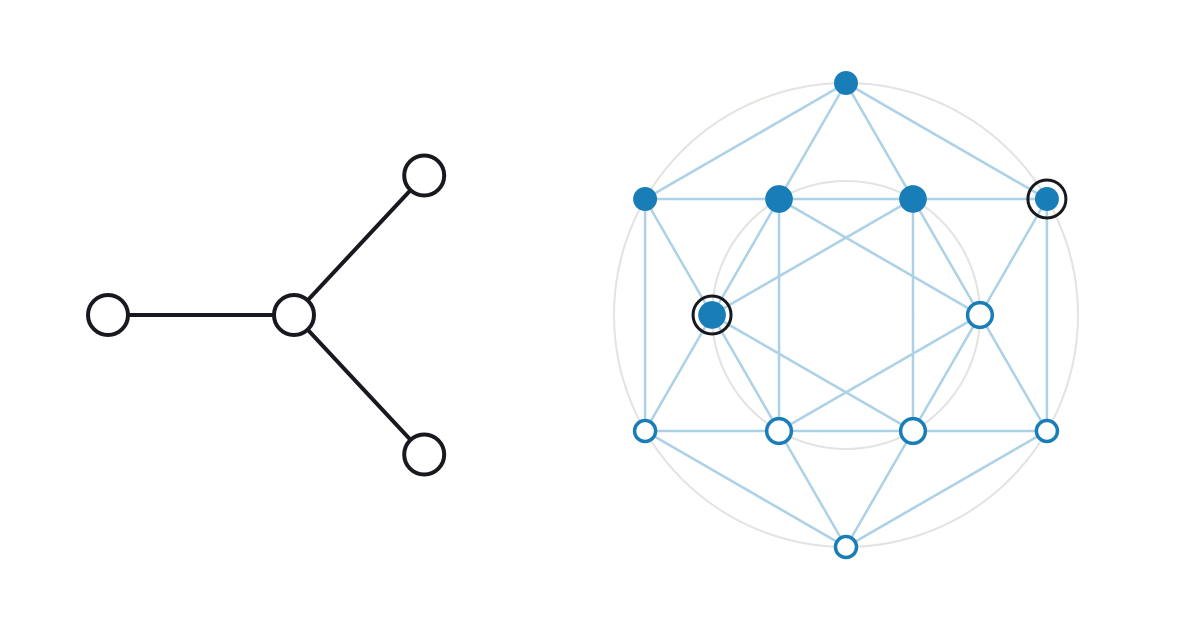
Highest weight representations
An irreducible finite-dimensional representation of a simple Lie algebra is determined by its highest weight , and denoted . Explore its weights and their multiplicities, tensor products, Verma modules, and the representations of affine Lie algebras.
Lie algebras
Weights and multiplicities
The irreducible finite-dimensional representations of a simple Lie algebra are the with highest weight , one for each dominant integral weight . is the sum of its weight spaces , on which a Cartan subalgebra acts by the weight , and the multiplicity of is . The weights are the points of , the root lattice, in the convex hull of the orbit of the Weyl group, and permutes them, preserving their multiplicities [4, §21].
So the multiplicities of the dominant weights determine all the others, and Freudenthal’s formula computes them one after another, starting from [4, §22.3]:
where is half the sum of the positive roots. The multiplicities add up to the dimension, given by Weyl’s formula as a product over the positive roots [4, §24]:
For , with , the being the numbers on the nodes of its Dynkin diagram, corresponds to the partition with boxes in row . The multiplicity of is the number of semistandard tableaux of this shape and weight , where a tableau with entries equal to has weight [2, Lecture 15].
Hexagons and triangles
For and , the weights lie on nested hexagons and, inside them, on triangles. The multiplicity is on the outer hexagon, one more on each hexagon further in, and on every triangle [2, Lecture 13].
The relief
The relief draws the multiplicities of , in rank two, as the heights of columns, one on each weight. Its shape has a limit as is scaled up [3]. Let be the number of positive roots not orthogonal to , minus the rank. Shrunk by across and by in height, the relief of tends to the graph of a function on the convex hull of that is a polynomial of degree on each of finitely many pieces: the density of the Duistermaat–Heckman measure of the coadjoint orbit through .
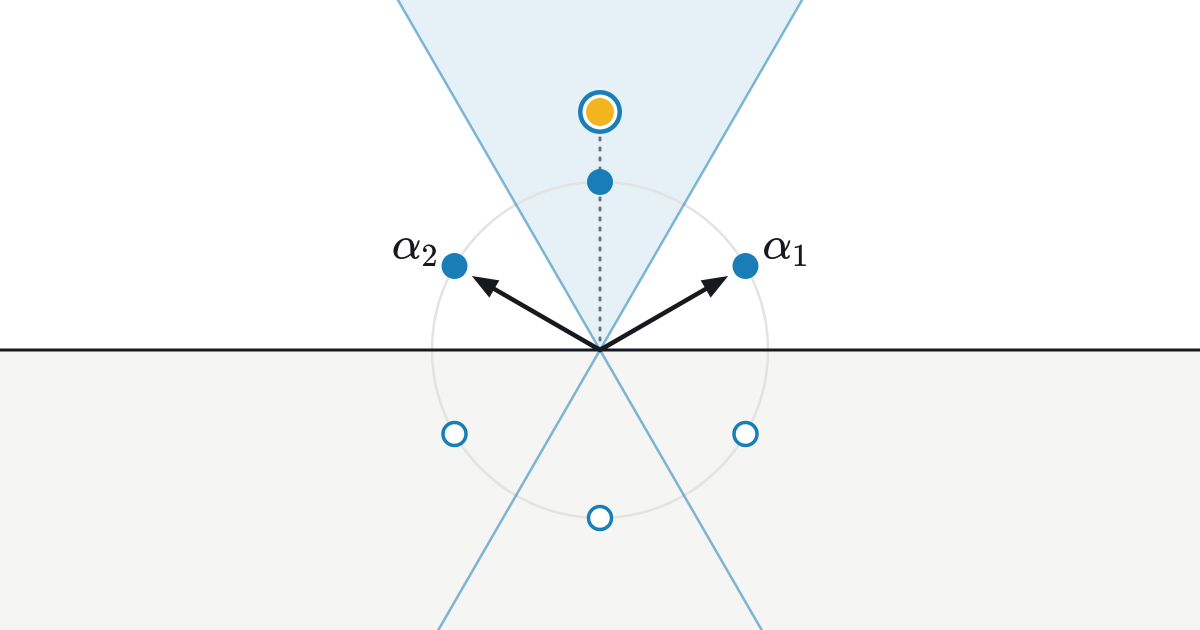
For off the walls of the dominant chamber, is for , for and for . For the limit rises linearly from the hexagon to the triangle and is flat on the triangle, as the multiplicities do.
Tensor products
The tensor product of two irreducible representations is a sum of irreducible ones,
and the Brauer–Klimyk rule computes the multiplicities from the weights of [4, §24]. Each weight of , of multiplicity , is placed at . A point in the dominant chamber adds copies of . A point outside it is moved into the chamber by the dot action , and adds copies of , where ; a point on a mirror through adds nothing. In all,
When lies so far inside the chamber that every is dominant, nothing moves, and .
Verma modules
The Verma module , for any weight , is generated by a vector of weight killed by the positive root vectors, with no other relations:
Its weights are the with a sum of positive roots, and the multiplicity of is Kostant’s partition function , the number of ways of writing as such a sum [5, Ch. 1]. has a unique simple quotient , which is when is dominant integral.
The dot action governs the submodules. If is a positive integer for a positive root , then contains , whose highest weight is ; if there is no such root, is simple [5, Ch. 4].
The character of is given by Kazhdan–Lusztig theory [5, Ch. 7–8]. The roots with an integer form a root system, whose Weyl group acts by the dot action. Let be the lowest weight in the orbit , and the shortest element of that takes to . Then
where are the Kazhdan–Lusztig polynomials of and is its Bruhat order. In rank one and two, is a dihedral group or smaller, and every is .
Affine Lie algebras
The affine Lie algebra is the central extension of the loop algebra by a central element , with a derivation added [6, Ch. 7]. Its Dynkin diagram is that of with one more node, , for the simple root , where is the highest root of and the smallest positive imaginary root.
A weight is given, up to a multiple of , by its labels , one for each node: , with the fundamental weights. The labels are the numbers on the Dynkin diagram next to the picture, where they can be changed.
The irreducible representation with highest weight is generated by a vector of weight killed by the positive root vectors. There is one for each [6, Ch. 9], and acts on it as the scalar
the level, where and .
The representation is integrable when the action of every and is locally nilpotent, each vector killed by a power of it. Then is a sum of finite-dimensional representations of the copy of spanned by , and , for each . This is so exactly when is dominant integral, every a non-negative integer [6, Ch. 10], and then the level is a non-negative integer too; these are the the picture allows with the Any weight option off.
The weights of an integrable are the conjugates, under the affine Weyl group, of the dominant weights below , and Freudenthal’s formula gives their multiplicities, with the imaginary roots counted times [6, Ch. 11]. Each weight lies on a string , , below a maximal weight [6, Ch. 12], and the picture draws at steps below . Every weight has , so the weights lie in a paraboloid [6, Ch. 11].
For simply laced, here and , the multiplicity of in the basic representation , for in , is the number of partitions of into parts of colours [1]:
Verma modules
The Verma module , for any weight , is generated by a vector of weight killed by the positive root vectors of , with no other relations:
Its weights are the with a sum of positive roots, and the multiplicity of is the number of ways of writing as such a sum, each imaginary root counted times [6, Ch. 9]. has a unique simple quotient , the integrable one above when is dominant integral.
With the dot action of the affine Weyl group: if is a positive integer for a positive real root , then , whose highest weight is , is a subquotient of . When there is no such root, is itself, unless the level is critical [7]: , where is the dual Coxeter number, and then . For the critical level is . For the critical level is . For the critical level is . For the critical level is .
For off the critical level the integral Weyl group is dihedral, finite or infinite, its Kazhdan–Lusztig polynomials are all , and is an alternating sum of characters of Verma modules [8]. Otherwise is built from its definition, one weight space after another: a vector below is zero in exactly when every sends it to zero.