Root systems
Root systems of rank two and three: finite, affine and hyperbolic types, and Lie superalgebras. For higher rank, see Dynkin diagrams.
Root systems of rank two and three
Dynkin diagram
Selected root
Reflections and the Weyl group
A root system lies in a real vector space with a symmetric bilinear form . A real root , one with , has the reflection
which preserves the form and the set of roots. These reflections generate the Weyl group [4, Ch. 3].
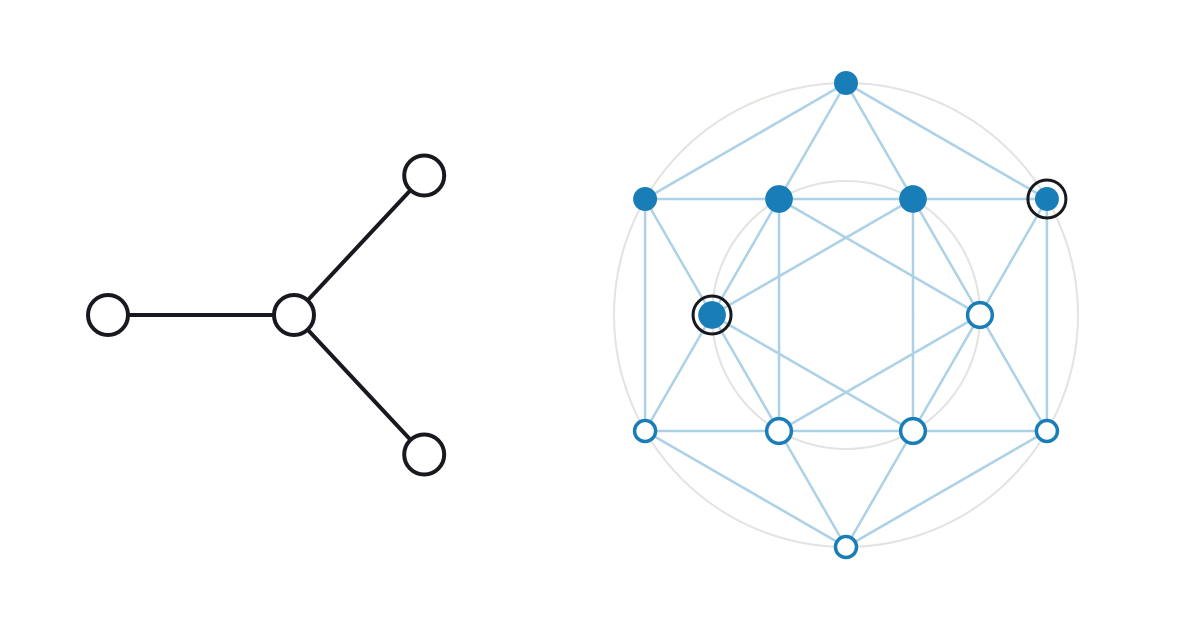
In the picture above, the handle is a linear functional . The roots with are positive, drawn filled, and the others negative, drawn hollow. The mirror of is the set of functionals with , which fixes; the mirrors cut the functionals into chambers, and permutes the chambers, taking any one to any other in exactly one way [4, Ch. 3].
Positive and simple roots
A functional that is nonzero on any root splits the roots into positive and negative ones. The simple roots are the positive roots that are not sums of two positive roots, and every positive root is a sum of simple roots with nonnegative integer coefficients [2, §10.1]. The functionals with the same positive roots form a chamber, shaded round the handle, whose walls are the mirrors of the simple roots; the Dynkin diagram beside the picture is read off them.
When the handle crosses the wall of a simple root , the simple roots are replaced by their images under , so becomes negative and the diagram stays the same. The positive roots are therefore for some in , written beside the picture as a word in the reflections of the simple roots [4, Ch. 3]. In affine and hyperbolic type the chambers fill only the functionals that are nonzero on , or that lie inside the null cone [4, Ch. 5].
Three geometries
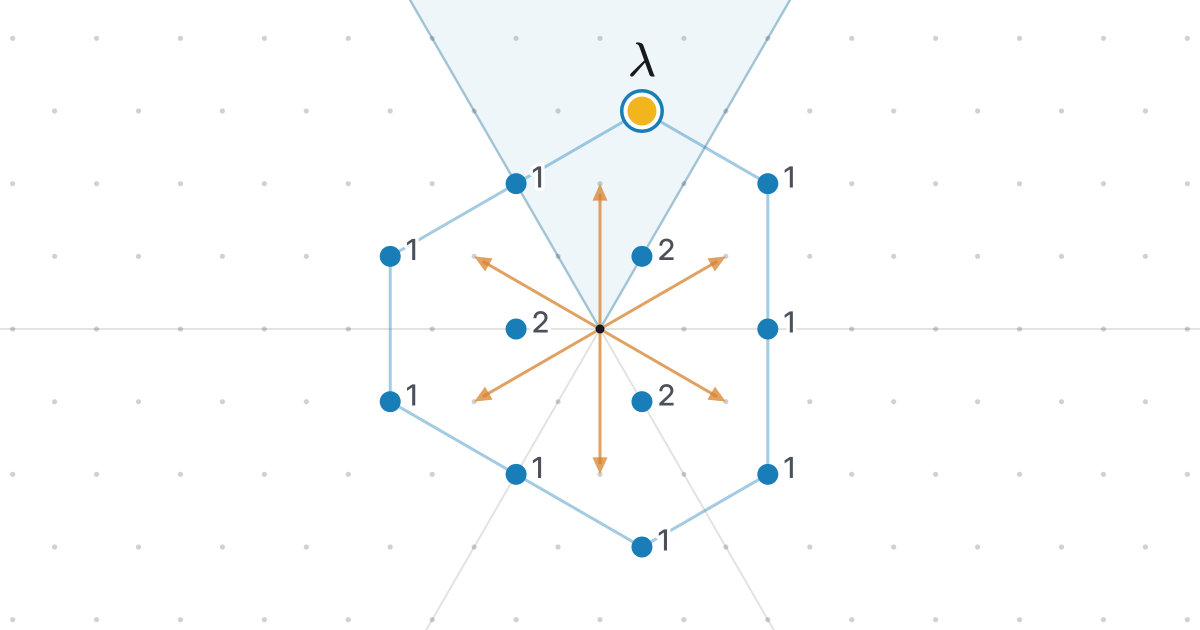
The symmetric bilinear form decides how the picture is drawn. In finite type it is positive definite and there are finitely many roots; in rank three each root is drawn where its ray meets the sphere, and the mirrors cut the sphere into triangles. In affine type it is positive semidefinite, with radical spanned by a root ; the functionals with form a Euclidean plane, which the mirrors cut into alcoves. In hyperbolic type it has signature ; the functionals inside the null cone, up to scale, form the hyperbolic plane, drawn as the Poincaré disc, which the mirrors cut into triangles with angles .
A root is real when , and imaginary when [4, Ch. 5]. Imaginary roots occur only in affine and hyperbolic type: the multiples , , in affine type, and in hyperbolic type every nonzero point of the root lattice with [4, Proposition 5.10]. Their multiplicities, the dimensions of their root spaces, can exceed ; we compute them by Peterson’s recursion [4, Exercise 11.11].
Superalgebras
The Lie superalgebras here have even and odd roots [3]. The even roots have reflections, which generate the Weyl group of the even part. An odd root with has the same reflection as the even root ; an isotropic one, with , has none, and its mirror is dashed.
Positive systems still come from functionals, but they need not be conjugate under . Crossing the mirror of an isotropic simple root is an odd reflection: becomes , each simple root with becomes , and the others stay [1, Ch. 1]. The Dynkin diagram changes with them, and so does the parity of its nodes: white for even, crossed for isotropic, black for the other odd roots.