Picard–Lefschetz formula
For a function with isolated nondegenerate critical points, Picard–Lefschetz theory describes how its fibres change as goes round a critical value of . Each fibre has a vanishing cycle for each critical value , an -sphere that shrinks to a point as goes to , where . Taking once round changes each cycle of by the Picard–Lefschetz formula, .
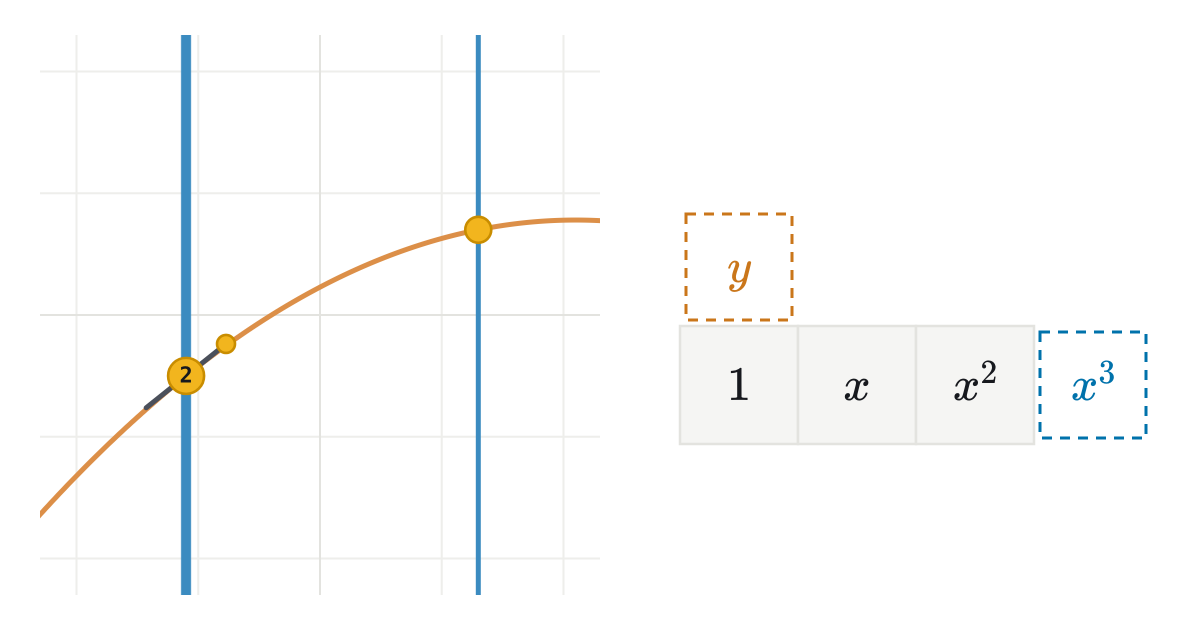
Drag critical points to move them.
Drag once round one of the to see the monodromy.
Carried along with
Intersection form
Vanishing cycles
Consider a holomorphic function on a complex manifold of dimension whose critical points are isolated and nondegenerate, with distinct critical values, and which has no critical points at infinity. Near a critical point with critical value , is a sum of squares
for suitable coordinates round it, and for with small , the nearby fibre is, near the critical point,
and contains a sphere , the vanishing cycle, where all , which shrinks to a point as . Strictly speaking, the vanishing cycle is the class
represented by the sphere , well-defined up to its orientation (in reduced homology when ). Picard–Lefschetz theory describes what happens to cycles when goes round a critical value , which only depends on this local form.
Here, we follow one example in which all of this can be seen in a plane. Take , and consider the function
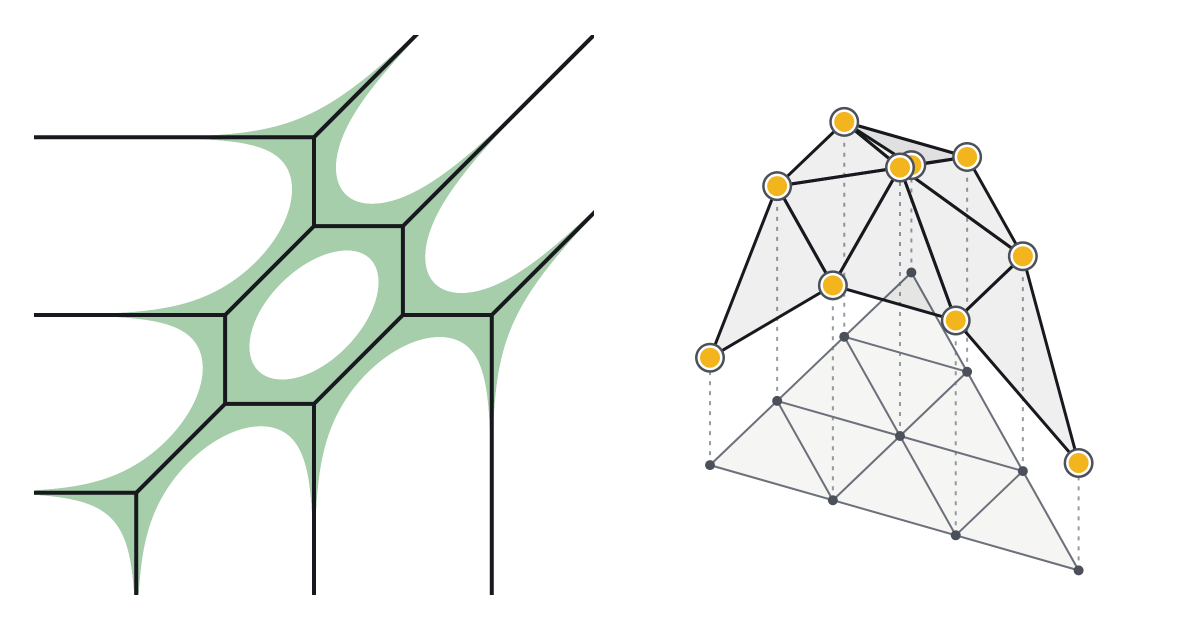
where is a monic polynomial of degree with simple critical points and distinct critical values . The critical points of are the points , and the level set is a smooth complex manifold for every other than . It is homotopy equivalent to a bouquet of spheres , as can be seen from the picture at the top, so that
(in reduced homology for , where is points), and it has a basis given by the vanishing cycles , each obtained by moving towards along a straight path, as long as it does not pass through any other .
The Picard–Lefschetz formula
Let be the loop that goes from along the straight path to near , once round counterclockwise, and back. Carrying the cycles of along gives an automorphism of , called the monodromy, and it is given by the Picard–Lefschetz formula
where is the intersection form of , defined with its complex orientation [1, Ch. 1]. The picture at the top shows this: take once round , by hand or from the bar, and the cycles that meet come back running along it.
The self-intersection of a vanishing cycle is
So for odd , and is the reflection in the hyperplane orthogonal to . For even , and is a transvection; for it is the action of the Dehn twist of the curve about the circle .
On the other hand, the basis given by straight paths in the picture at the top does not change after goes round : it is the same basis when is back (choose Show to see it). Instead it jumps where crosses a Stokes ray, the ray from away from : there the straight path to runs through , runs into , and across the ray the path to changes by the loop , so that becomes . The thimbles of Stokes phenomenon jump in the same way.
The intersection form
The arcs of a basis meet only at their ends. Two vanishing cycles whose arcs share an end meet once, at the point over it, and ; cycles over disjoint arcs do not meet. The form is symmetric for odd and skew-symmetric for even , and increasing by changes its sign without changing the monodromy [1]:
For , is positive definite, and the vanishing cycles are roots of the root system (see Root systems); the basis the page opens with is a chain, with the Dynkin diagram of . Where crosses a Stokes ray the basis changes, and so does the diagram, though the lattice it describes does not.
Monodromy
When travels along a loop which is a product of the loops and their inverses, the monodromy of the loop is the automorphism which is the product of the corresponding operators , which preserves the intersection form. The fundamental group of the plane without the critical values is a free group generated by the loops , so these loops give all the possible monodromies.
The monodromy group is the group generated by . For odd these are reflections, and they generate the Weyl group of , the symmetric group on letters; for it permutes the points of . For the group is infinite: for , is a punctured torus and the group is .
The monodromy for the loop that goes once round all the critical values is the classical monodromy [1]. That loop can be widened to a large circle, far from all the critical values, so up to conjugation stays the same when the critical points move, and its eigenvalues do not change. Bringing the critical points together at gives , whose monodromy has eigenvalues for ; in the basis the page opens with it takes to .